Directory

Office: Engineering D105
Phone: 9704915870
Education:
- Ph.D., Princeton University (2014)
- B.S., MIT (2008)
About
My research has been focused on understanding how to utilize the LArTPC (Liquid Argon Time Projection Chamber) technology for precision neutrino physics, with an emphasis on detector calibration and R&D of cryogenic electronics. I am participating in several LArTPC accelerator neutrino experiments, namely MicroBooNE (Micro Booster Neutrino Experiment), the SBN (Short-Baseline Neutrino) program, and DUNE (Deep Underground Neutrino Experiment), all of which utilize neutrino beams produced at Fermilab near Chicago, Illinois. The physics goals of these experiments include searching for a hypothetical particle known as a “sterile neutrino” and determining if neutrinos are responsible for the matter-antimatter asymmetry in the universe.
Research Interests
The neutrino is a ubiquitous particle in our universe, originating from the Sun, the Earth’s core and atmosphere, supernovae, the Big Bang, and man-made sources such as nuclear reactors and particle accelerators. Despite its omnipresence, it remains the least understood known fundamental particle due to its weak interactions with other particles (and thus particle detectors). One surprising discovery in the last few decades is the experimental confirmation of neutrino oscillation, opening up many other questions in the field. What is the origin and ordering of neutrino mass, which enables these oscillations? Do neutrinos of the Standard Model mix with other undiscovered states (sterile neutrinos) as well? And are neutrinos at the heart of the matter-antimatter asymmetry of the universe?
One promising detector technology that can be used to answer many of these questions is the liquid argon time projection chamber (LArTPC), an imaging detector that can be used to “photograph” neutrino-nucleus interaction events. This detector technology offers excellent spatial resolution that can be used to study the neutrino in unprecedented detail. My research has been focused on understanding how to utilize the LArTPC technology for precision neutrino physics, including calibrating the detector for surface operation, developing novel techniques for the reconstruction of neutrino interaction events, and research and development of cold (inside LAr) electronics used to minimize noise levels in the detector. I am participating in several LArTPC accelerator neutrino experiments, namely MicroBooNE (Micro Booster Neutrino Experiment), the SBN (Short-Baseline Neutrino) program, and DUNE (Deep Underground Neutrino Experiment), all of which utilize neutrino beams produced at Fermilab near Chicago, Illinois.
Previously I worked on the Compact Muon Solenoid (CMS) experiment of the Large Hadron Collider (LHC) at CERN in Geneva, Switzerland, participating in the successful search for the Higgs boson (discovered in 2012).
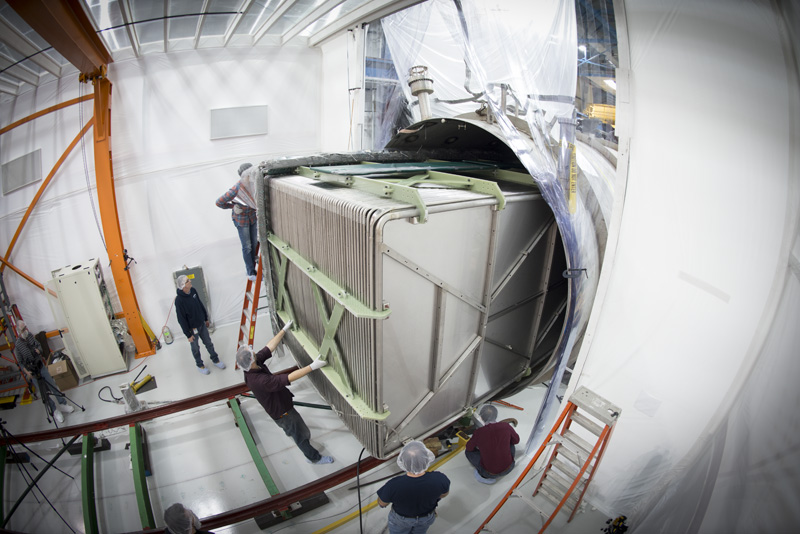
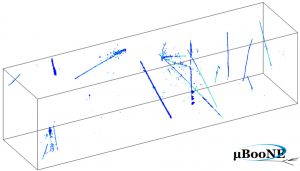
MicroBooNE TPC during installation into cryostat (left) and 3D imaging of neutrino interaction event in MicroBooNE LArTPC (right).
© Colorado State University - College of Natural Sciences, Fort Collins, CO 80523
