|
Ultrasonic spectroscopy has been used for many years at Colorado State
University as a sensitive probe of condensed matter. The current focus
is on a powerful new technique called Resonant Ultrasound Spectroscopy.
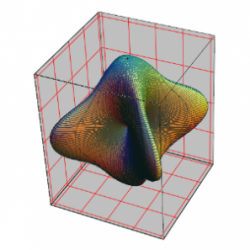
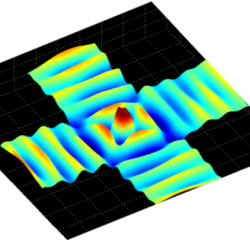
RUS involves the excitation of the vibrational eigenmodes of a small sample,
usually in the shape of a rectangular parallelepiped. A calculated eigenmode
for one particular parallelepiped is illustrated at the upper left of
this page. A RUS spectrum of a single sample of mm dimensions yields the
full set of elastic constants, even for relatively low-symmetry materials.
In addition, the Qs of the resonances provide information about
slow dynamic process difficult to investigate with many other techniques.
The Ultrasonics Laboratory at Colorado State is equipped with state of
the art electronics, as well as cryostats and furnaces, to carry out measurements
under a wide range of conditions. The philosophy is to use the unique
facilities at Colorado State to perform collaborative research on novel
and interesting materials with researchers at other universities and national
laboratories in the United States as well as elsewhere.
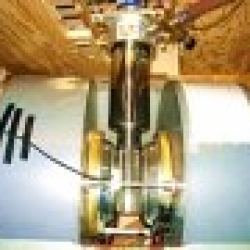
Sample
in RUS Spectrometer
Parallelepiped sample mouted in RUS spectrometer. The sample is approximately
one mm on an edge.
|