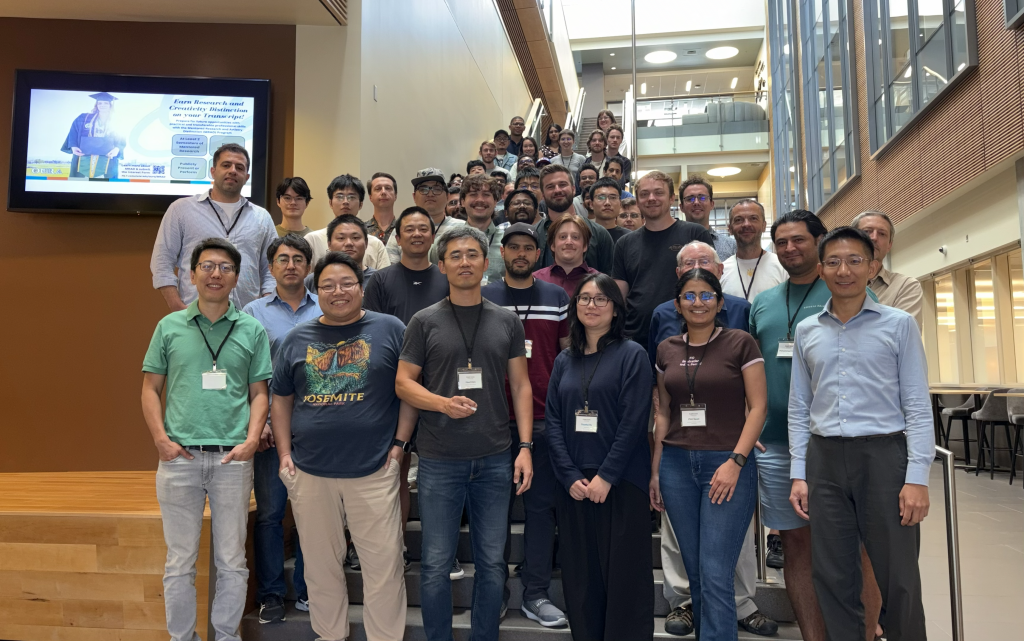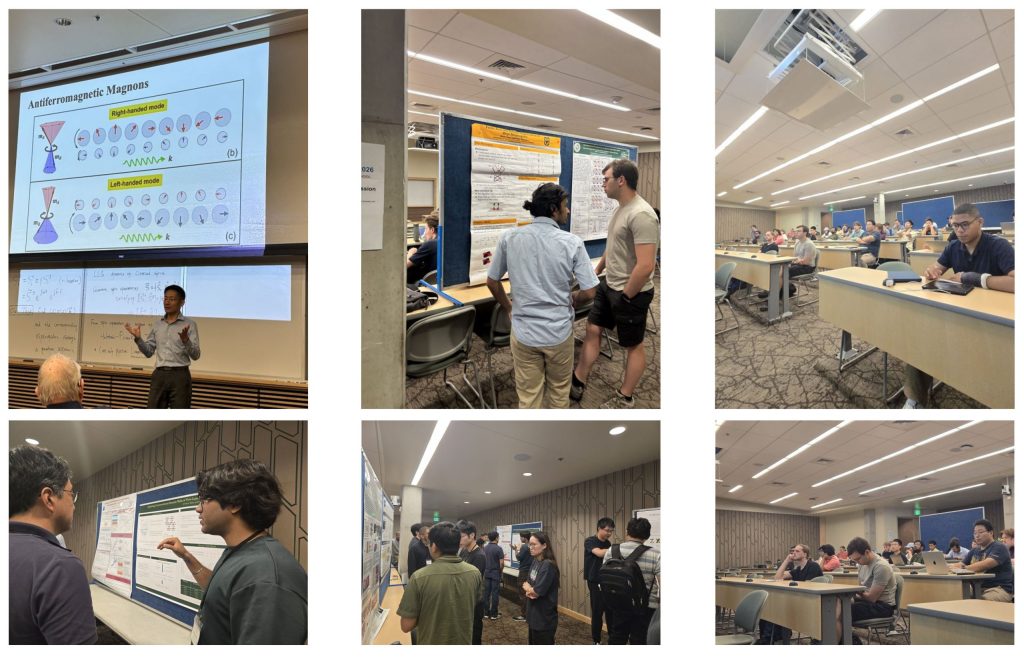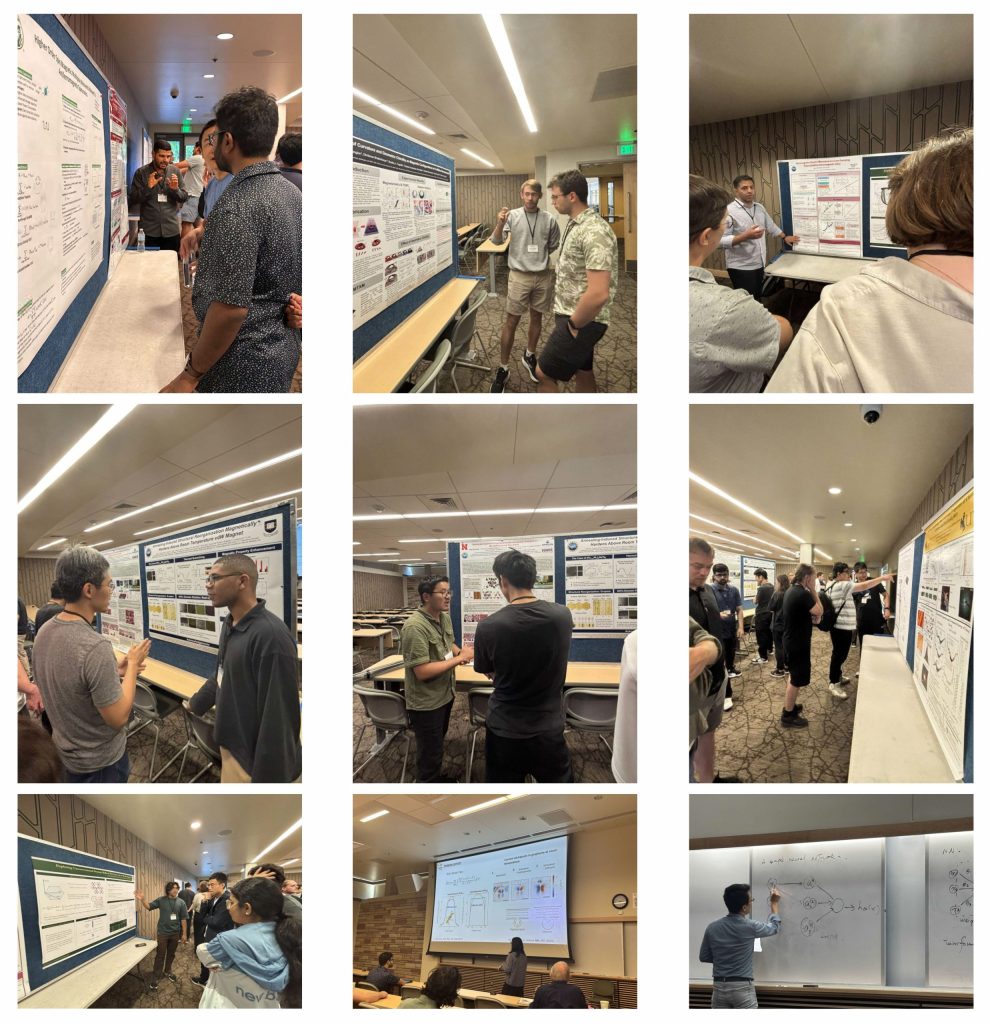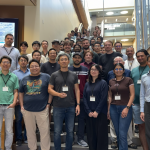
Colorado State University hosted more than 50 students, postdoctoral researchers, faculty members and scientists July 13-17 for the 2026 Principles and Applications of Symmetry in Magnetism (PASM) Summer School. Held in the Scott Bioengineering Building on CSU’s Fort Collins campus, the five-day program combined advanced instruction with sustained opportunities for discussion and collaboration.
Supported by the National Science Foundation and CSU Physics Department, PASM 2026 was designed to introduce early-career researchers to modern spin-related physics while connecting people working across theory, computation and experiment. Participants came from universities and national laboratories in the United States and abroad.
Symmetry served as the unifying language for a program spanning antiferromagnetic dynamics, quantum sensing, electron correlations, topological transport, unconventional magnetism, quantum geometry and artificial intelligence-assisted materials research. The school emphasized the conceptual relationships among them and their relevance to emerging magnetic and quantum technologies.
Seven invited lecturers led multi-part courses during the week: Ran Cheng of UC Riverside on antiferromagnetic dynamics; Chunhui Du of Georgia Tech on quantum sensing of quantum materials; Satoshi Okamoto of ORNL on electron correlations and Hall effects; Yaroslav Tserkovnyak of UCLA on symmetry-enabled topological transport and entanglement generation; Binghai Yan of Penn State on unconventional magnetism and quantum geometry; Gen Yin of Georgetown University on computational quantum geometry; and Qimin Yan of Northeastern University on symmetry and artificial intelligence. The schedule reserved time each day for questions and broader discussion, allowing ideas introduced in one lecture series to carry into the others.
The program also featured 24 participant presentations organized into three thematic poster sessions. The sessions covered magnetic textures, dynamics and imaging; spin transport, torques and devices; and altermagnets, topology, quantum geometry and materials design. For many participants, the posters provided a first opportunity to discuss developing research directly with junior and senior researchers in closely related fields outside their home institutions.
The combination of lectures, posters and informal conversations was central to the school’s purpose. It gave graduate students and postdoctoral researchers a setting in which to ask detailed questions, compare theoretical and experimental perspectives, and build connections with peers working on related problems.
PASM 2026 was organized by Hua Chen, associate professor of physics at CSU and chair of the organizing committee; Ran Cheng of UC Riverside; and Qimin Yan of Northeastern University. CSU physics graduate students Reaz Bhuiyan, Sparsh Ghimire, Achintya Mitra, and Afsana Sharmin assisted with on-site organization and participant logistics. The organizers also gratefully acknowledge Theo Kanbe and Krysta Loeser for their essential administrative and logistical support.
Selected lecture materials, the complete program and additional photographs are available on the PASM 2026 website:
https://magnetics.colostate.edu/pasm2026/s are available on the PASM 2026 website: 2026 Principles and Applications of Symmetry in Magnetism Summer School – Center for Advanced Magnetics | CSU