October 17, 2025
Join us during Homecoming Weekend as we celebrate the 60th anniversary of CSU’s Madison-Macdonald Observatory.
All events are free and open to the public.
Schedule of Events
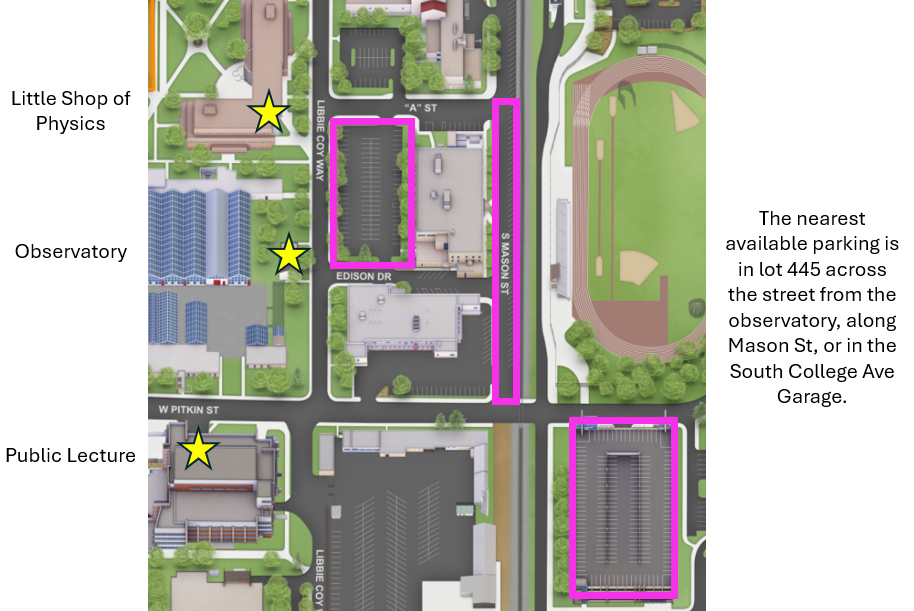
| Time | Activity | Location (see map below) |
|---|---|---|
| 3 – 6 pm | Solar Observing | Festival on the Oval |
| 6:30 pm | Public Lecture: The Exoplanet R(E)volution |
Biology 136 251 W. Pitkin Street |
| 7, 7:30, and 8 pm | Map of the Universe | NESB A302 (3rd Floor) 1231 Libbie Coy Way |
| 7 – 8:15 pm | Sol Trek | Sidewalk between NESB and Observatory |
| 7 – 8:15 pm | Little Shop of Physics | NESB Atrium and 3rd Floor 1231 Libbie Coy Way |
| 7:15 – 8:30 pm | Stargazing | Madison-Macdonald Observatory 1251 Libbie Coy Way |
Stop by the Festival on the Oval where the Astronomy Club will have a variety of solar telescopes set up for folks to safely observe solar flares and sunspots.
The Exoplanet R(E)volution
Since the first planets beyond our solar system were discovered in 1992, we have confirmed the existence of over 6000 exoplanets! There are many techniques for finding exoplanets using both ground and space-based telescopes. As we continue to study exoplanet populations in greater detail, we are just now starting to peer into the atmospheres of some of these worlds. Over the next few decades, we expect the number of known exoplanets to continue to grow, and our goal is to use the next generation of telescopes to find Earth-analog exoplanets so we can search their atmospheres for signs of life.
Speaker Bio
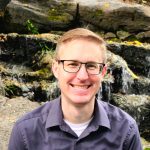 Dr. Kevin Hardegree-Ullman is a research scientist at the NASA Exoplanet Science Institute at Caltech. He maintains and updates the NASA Exoplanet Archive which is an actively growing database of all known exoplanets. Kevin got his bachelor’s degree at The University of Arizona followed by his Ph.D. at The University of Toledo in 2018. He has worked with scientists around the world to discover and characterize exoplanets and their host stars, study exoplanet populations, and run simulations that predict the capabilities of next generation telescopes to detect exoplanet biosignatures.
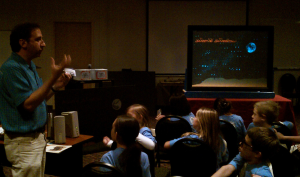 Map of the Universe
Drop by room A302 in NESB to take a journey starting from 500 million light years out into the universe and heading back to our home habitable planet. Dr. Andrew Warnock, director of the Natural Sciences Education and Outreach Center, will be your guide for this memorable 3D adventure. Show times are at 7:00, 7:30, and 8:00 PM. Space is limited to 24 seats.
Sol Trek
Understanding the speed of light is essential for interpreting our universe. Mr. Dave Swartz, Master Teacher-in-Residence at the Natural Sciences Education and Outreach Center, will demonstrate light speed using a string of LEDs along the sidewalk of Libby Coy Way between NESB and the Madison-Macdonald Observatory. Flow with the photons of the Sun as they race across space for the 8 minute and 20 second journey to Earth!
 Check out some neat hands-on science experiments over at the Little Shop of Physics. Their Engagement Spaces on the 3rd floor include both a Dark Room and a Light Room, and there will be a gravity well set up in the Atrium.
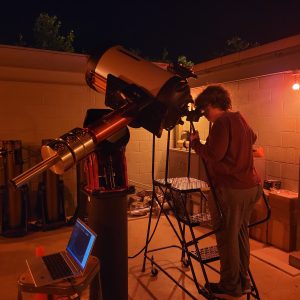
Take a peek through our recently renovated main telescope to see Saturn, the Ring Nebula, star clusters, and the Andromeda Galaxy.
We will also have CSU’s original Alvan Clark refractor set up on the lawn outside the observatory. In the 60 years before the observatory opened, both Les Madison and Stuart Macdonald used this telescope for teaching astronomy.
If you are interested in learning how to use a telescope, visit one of our Dobsonian telescope stations. Our telescope operators can teach you how to align the finder scope, find objects on the sky, and bring them into focus with different magnifications.
Location