 |
Professor B.S., University of Toronto (1979) Ph.D., Stanford University (1985) |
Theory of Nanoscale Pattern Formation Induced by Ion Bombardment of Solid Surfaces
When an energetic ion strikes a solid surface, one or more atoms can be ejected from the solid. Bombarding a flat solid surface with a broad ion beam therefore results in erosion of the solid. Naively, one would expect that the solid surface would simply remain flat as it is eroded. Instead, a remarkable variety of self-assembled nanoscale patterns can form, including periodic height modulations or “ripples,” mounds arranged in hexagonal arrays of astonishing regularity, and arrays of sharply pointed conical protrusions (see the picture gallery below). The spontaneous emergence of these patterns is not just fascinating in its own right, since in the future ion bombardment may prove to be an important tool in the fabrication of nanostructures.
At the present time, many aspects of the self-organization induced by ion bombardment are not fully understood. Our group is working closely with experimentalists to provide answers to many of the open questions in the field. We are using continuum modeling, the mathematical theory of pattern formation, and computer simulations in our research.
The first type of pattern formation to be discovered was the ripples that often develop when the nominally flat surface of a solid is eroded by oblique-incidence ion bombardment. According to the widely accepted Bradley-Harper theory, this is a result of a surface instability caused by the curvature dependence of the erosion velocity: The erosion velocity is greater in a trough than at a crest.
In 1999, experiments by Facsko et al. revealed that normal-incidence ion bombardment of the binary compound gallium antimonide can lead to the formation of nanoscale mounds or “nanodots” arranged in a beautifully ordered hexagonal array. Recently, Mark Bradley and Patrick Shipman (CSU Math) developed a theory that explains the genesis of these arrays. In our theory, the coupling between the topography of the surface and a surface layer of altered composition is the key to the observed pattern formation. A sequence of snapshots from a simulation of our model shows the development of a highly ordered array of nanodots (see the picture gallery below).
Photo Gallery
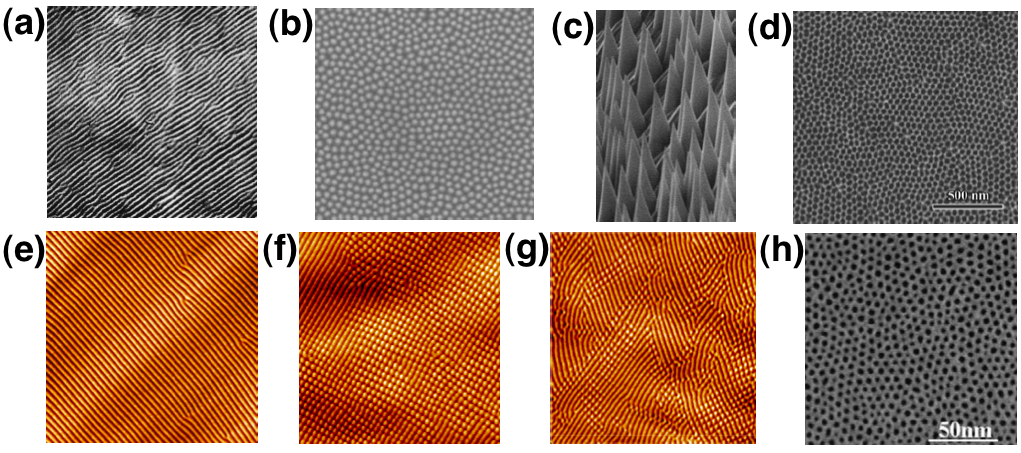
A selection of topographies generated by ion bombardment. (a) Ripples produced by oblique-incidence ion bombardment of silica (M. Navez et al. 1962). (b) An array of nanodots with short range hexagonal order formed by normal-incidence bombardment of GaSb (S. Facsko et al. 1999). (c) A forest of cones on copper (R. Reiche and W. Hauffe 2000). (d) A well-ordered hexagonal array of nanoholes produced by normal-incidence bombardment of Ge (Q. Wei et al. 2009). (e) Nearly defect-free ripples produced by bombardment of Si at a 15 degree angle of incidence (B. Ziberi et al. 2009). (f) A near perfect square array of nanodots created by bombardment of Si at a 26 degree angle of incidence (B. Ziberi et al. 2009). (g) Ripples of two different wave vectors produced by bombardment of Si at a 25 degree angle of incidence (B. Ziberi et al. 2009). (g) Nanorods of Al in a Si thin film produced by magnetron sputtering (T. Saito et al. 2009).
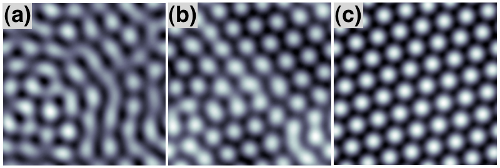
A sequence of snapshots from a simulation of our model for the formation of highly ordered arrays of nanodots. The initial state was a nearly flat, rough surface. Each snapshot was taken looking down at the surface. High points are white and low points are black, and time increases from left to right.
Available Positions
Inquiries are welcome from prospective graduate students and from interested undergraduates. Our group offers exciting research experiences in analytical and computational theoretical physics and is supported by two grants from the National Science Foundation. Students in our group receive training in the physics of ion-solid interactions and in the modern mathematical theory of pattern formation in nonequilibrium systems.
Selected Publications
- R. M. Bradley, J. M. E. Harper and D. A. Smith, “Theory of Thin Film Orientation by Ion Bombardment during Deposition,” J. Appl. Phys. 60, 4160 (1986) Link.
- R. M. Bradley and J. M. E. Harper, “Theory of Ripple Topography Induced by Ion Bombardment,” J. Vac. Sci. Technol. A 6, 2390 (1988) Link. (Now cited over 1,100 times according to Web of Science.)
- R. M. Bradley and E.-H. Cirlin, “Theory of Improved Resolution in Depth Profiling with Sample Rotation,” Appl. Phys. Lett. 68, 3722 (1996) Link.
- R. M. Bradley, “Dynamic Scaling of Ion-Sputtered Rotating Surfaces,” Phys. Rev. E 54, 6149 (1996) Link.
- R. M. Bradley and P. D. Shipman, “Spontaneous Pattern Formation Induced by Ion Bombardment of Binary Compounds,” Phys. Rev. Lett. 105, 145501 (2010) Link.
- R. M. Bradley, “Redeposition of Sputtered Material is a Nonlinear Effect,” Phys. Rev. B 83, 075404 (2011) Link.
- R. M. Bradley, “Theory of Nanodot and Sputter Cone Arrays Produced by Ion Sputtering with Concurrent Deposition of Impurities,” Phys. Rev. B 83, 195410 (2011) Link.
- R. M. Bradley, “Exact Linear Dispersion Relation for the Sigmund Model of Ion Sputtering,” Phys. Rev. B 84, 075413 (2011) Link.
- P. D. Shipman and R. M. Bradley, “Theory of Nanoscale Pattern Formation Induced by Normal-Incidence Ion Bombardment of Binary Compounds,” Phys. Rev. B 84, 085420 (2011) Link.
- R. M. Bradley and P. D. Shipman, “A Surface Layer of Altered Composition Can Play a Key Role in Nanoscale Pattern Formation Induced By Ion Bombardment,” Appl. Surf. Sci. 258, 4161 (2012) [invited] Link.
- F. C. Motta, P. D. Shipman and R. M. Bradley, “Highly Ordered Nanoscale Surface Ripples Produced by Ion Bombardment of Binary Compounds,” J. Phys. D (Fast Track Communications) 45, 122001 (2012) Link. (Selected for inclusion in Journal of Physics D’s Applied Physics Highlights collection by the Journal’s Editors.)
- R. M. Bradley, “Producing Ripple Topographies by Ion Bombardment with Co-Deposition of Impurities: A Curvature Dependent Sputter Yield Is Not Required,” Phys. Rev. B 85, 115419 (2012) Link.
- R. M. Bradley, “Surface Instability of Binary compounds Caused by Sputter Yield Amplification ,” J. Appl. Phys. 111, 114305 (2012) Link.
- M. P. Gelfand and R. M. Bradley, “Highly Ordered Nanoscale Patterns Produced by Masked Ion Bombardment of a Moving Solid Surface,” Phys. Rev. B (Rapid Communications) 86, 121406 (2012) Link.
- R. M. Bradley, “Nanoscale Patterns Produced by Ion Erosion of a Solid with Co-deposition of Impurities: The Crucial Effect of Compound Formation,” Phys. Rev. B 87, 205408 (2013) Link.
- R. M. Bradley and K. W. Mauser, “Can the Atomic Yields Oscillate during Ion Sputtering of an Initially Homogeneous Multicomponent Alloy?,” J. Appl. Phys. 114, 033506 (2013) Link.
- R. M. Bradley, “Nanoscale Compositional Banding in Binary Thin Films Produced by Ion-Assisted Deposition,” J. Appl. Phys. 114, 224306 (2013) Link.
- S. A. Mollick, D. Ghose, P. D. Shipman and R. M. Bradley, “Anomalous Patterns and Nearly Defect-Free Ripples Produced by Bombarding Silicon and Germanium with a Beam of Gold Ions,” Appl. Phys. Lett. 104, 043103 (2014) Link.
- M. P. Harrison and R. M. Bradley, “The Crater Function Approach to Ion-Induced Nanoscale Pattern Formation: Craters for Flat Surfaces are Insufficient,” Phys. Rev. B 89, 245401 (2014) Link.
- F. C. Motta, P. D. Shipman and R. M. Bradley, “Theory of Nanoscale Pattern Formation Produced by Oblique-Incidence Ion Bombardment of Binary Compounds,” Phys. Rev. B 90, 085428 (2014) Link.
- R. M. Bradley and H. Hofsaess, “A Modification to the Sigmund Model of Ion Sputtering,” J. Appl. Phys. 116, 234304 (2014) Link.
- M. P. Gelfand and R. M. Bradley, “One Dimensional Conservative Surface Dynamics with Broken Parity: Arrested Collapse versus Coarsening,” Phys. Lett. A 379, 199 (2015) Link.
- D. A. Pearson and R. M. Bradley, “Theory of Terraced Topographies Produced by Oblique-Incidence Ion Bombardment of Solid Surfaces,” J. Phys.: Cond. Matt. 27, 015010 (2015) Link.
- H. M. Urbassek, R. M. Bradley, M. L. Nietiadi and W. Moller, “Sputter Yield of Curved Surfaces,” Phys. Rev. B 91, 165418 (2015) Link.
- H. Hofsaess and R. M. Bradley, “Tests of the Modified Sigmund Model of Ion Sputtering using Monte Carlo Simulations,” J. Appl. Phys. 117, 174310 (2015) Link.
- M. P. Harrison and R. M. Bradley, “Nanoscale Patterns Formed by Ion Bombardment of Rotating Binary Materials,” J. Phys.: Cond. Matt. 27, 295301 (2015) Link.
- D. A. Pearson, R. M. Bradley, F. C. Motta and P. D. Shipman, “Patterning Surfaces Before Ion Sputtering Can Yield Nanodot Arrays with Improved Hexagonal Order,” Phys. Rev. E 92, 062401 (2015) Link.
- B. Hashmi, P. D. Shipman and R. M. Bradley, “Highly Ordered Square Arrays of Nanoscale Pyramids Produced by Ion Bombardment of a Crystalline Binary Material,” Phys. Rev. E 93, 032207 (2016) Link.
- R. M. Bradley, “Morphological Transitions in Nanoscale Patterns Produced by Concurrent Ion Sputtering and Impurity Co-deposition,” J. Appl. Phys. 119, 134305 (2016) Link.
- M. P. Harrison and R. M. Bradley, “Producing Virtually Defect-Free Nanoscale Ripples by Ion Bombardment of Rocked Solid Surfaces,” Phys. Rev. E (Rapid Communications) 93, 040802 (2016) Link.
- T. Basu, D. A. Pearson, R. M. Bradley and T. Som, “Temporal Evolution of a Silicon Surface Subject to Low Energy Ion Irradiation and Concurrent Substrate Rotation,” Appl. Surf. Sci. 379, 480 (2016) Link.
- G. Hobler, R. M. Bradley and H. M. Urbassek, “Probing the Limitations of Sigmund’s Model of Spatially Resolved Sputtering Using Monte Carlo Simulations,” Phys. Rev. B 93, 205443 (2016) Link.
- G. Hobler, M. L. Nietiadi, R. M. Bradley and H. M. Urbassek, “Sputtering of Silicon Membranes with Nanoscale Thickness,” J. Appl. Phys. 119, 245105 (2016) Link.
- R. M. Bradley and H. Hofsass, “Nanoscale Patterns Produced by Self-Sputtering of Solid Surfaces: The Effect of Ion Implantation,” J. Appl. Phys. 120, 074302 (2016) Link.
- M. P. Harrison and R. M. Bradley, “Blazed Diffraction Gratings Produced by Ion Bombardment of Pre-patterned Solid Surfaces,” J. Appl. Phys. 121, 054308 (2017) Link.
- M. P. Harrison and R. M. Bradley, “Fabrication of High Quality Multilayer Blazed Diffraction Gratings Using Ion Beam Assisted Deposition,” J. Appl. Phys. 121, 225304 (2017) Link.
- M. P. Harrison, D. A. Pearson, and R. M. Bradley, “Emergence and Detailed Structure of Terraced Surfaces Produced by Oblique-Incidence Ion Sputtering,” Phys. Rev. E 96, 032804 (2017) Link.
- H. M. Urbassek, M. L. Nietiadi, R. M. Bradley and G. Hobler, “Sputtering of SicGe1-c Nanospheres,” Phys. Rev. B 97, 155408 (2018) Link.
- F. C. Motta, R. Neville, P. D. Shipman, D. A. Pearson, and R. M. Bradley, “Measures of Order for Nearly Hexagonal Lattices,” Physica D 380 – 381, 17 (2018) Link.
- K. M. Loew and R. M. Bradley, “The Effect of Dispersion on the Nanoscale Patterns Produced by Ion Sputtering,” Phys. Rev. E 100, 012801 (2019) Link.
- R. M. Bradley, “Theory of Nanoscale Ripple Topographies Produced by Ion Bombardment Near the Threshold for Pattern Formation,” Phys. Rev. E 102, 012807 (2020) Link.
- K. M. Loew and R. M. Bradley, “Parameter Estimation for Pattern Formation Induced by Ion Bombardment of Solid Surfaces Using Deep Learning,” J. Phys.: Condens. Matter 33, 025901 (2020) Link.
- D. Erb, R. de Schultz, A. Ilinov, K. Nordlund, R. M. Bradley and S. Facsko, “Nanopatterning of the (001) Surface of Crystalline Ge by Ion Irradiation at Off-Normal Incidence: Experiment and Simulation,” Phys. Rev. B 102, 165422 (2020) Link.
- R. M. Bradley and T. Sharath, “Nanoscale Pattern Formation on Solid Surfaces Bombarded by Two Broad Ion Beams in the Regime in which Sputtering is Negligible,” Phys. Rev. E 103, 022804 (2021) Link.
- R. M. Bradley and T. Sharath, “Theory of Nanoscale Surface Ripple Formation During Oblique-Incidence Thin-Film Deposition,” J. Appl. Phys. 129, 175303 (2021) Link. (Selected as an Editor’s Pick.)
- R. M. Bradley and G. Hobler, “Second order corrections to the sputter yield of a curved surface,” J. Appl. Phys. 129, 194301 (2021) Link.
- J. Li, G. Yang, R. M. Bradley, Y. Liu, F. Frost, Y. Hong, “Enhancing the quality of self-organized nanoripples by Ar-ion bombardment of a bilayer system,” Nanotechnology 32, 385301 (2021) Link.
Complete List of Mark Bradley’s Publications
Recent Bradley Group Highlights
2021
- I will be an invited speaker at the Sixth International Conference on Nanostructuring by Ion Beams, which will be held online from October 5 to 8, 2021.
2020
- Invited speaker at the virtual conference Ion Beams in Materials Engineering and Characterization, which was held from December 8 to 11, 2020.
2019
- Invited speaker at the SIAM Conference on Applications of Dynamical Systems, which was held from May 19 to 23, 2019 in Snowbird, UT.
2018
- Invited speaker at the 2018 SIAM Conference on Mathematical Aspects of Materials Science, which was held from July 9 to 13, 2018 in Portland, OR.
- Invited speaker at the International Conference on Applications of Accelerators in Research and Industry (CAARI) which was held from August 12 to 17 in Grapevine, TX. I was also the Co-Topic Editor for the four sessions that will be held on Nanoscience and Technology and the organizer of two sessions on Nanoscale Surface Patterns Produced by Broad Beams of Particles.
- Graduate student Dan Pearson successfully defended his doctoral thesis. Congratulations, Dan!
2017
- Invited speaker at the Four Corners Meeting of the American Physical Society which was held from October 20 to 21 in Fort Collins, CO.
- Invited speaker at the 3rd Annual SIAM Central States Section Conference which was held from September 29 to October 1, 2017 in Fort Collins, CO.
- Invited speaker at the conference Colorado Nonlinear Days which was held on November 11 and 12 in Colorado Springs, CO.
- Graduate student Matt Harrison successfully defended his doctoral thesis. Congratulations, Matt!
2016
- Invited speaker at the SIAM Conference on Mathematical Aspects of Material Science, which was held from May 8 to 12, 2016 in Philadelphia. Graduate students Matt Harrison and Dan Pearson gave contributed talks.
- Invited speaker at the conference Colorado Nonlinear Day which was held on April 30, 2016 in Colorado Springs, CO.
- I gave an invited talk at the International Conference on Applications of Accelerators in Research and Industry (CAARI) which was held from October 30 to November 4, 2016, in Fort Worth, TX. I was also the Co-Topic Editor for the six sessions that were be held on Nanoscience and Technology and the organizer of two sessions on Nanoscale Pattern Formation at Surfaces.
- Invited speaker at the Materials Research Society Fall Meeting, which was held from November 27 to December 2, 2016 in Boston.
- An undergraduate who did research with me (Zhongruo Wang) is now a graduate student in the Department of Mathematics at UC Davis. Congratulations, Zhongruo!
2015
- Our proposal to the NSF, “Ion Sculpting of Multilayer Gratings for Extreme Ultraviolet Applications” was funded. Carmen Menoni (CSU Electrical and Computer Engineering) is the PI and I am the co-PI.
- I was named an Editor for Nanophysics by the journal Open Physics.
- Invited speaker at the Materials Research Society’s Spring Meeting which was held from April 6 to 10 in San Francisco, CA.
- Invited speaker at the 8th International Workshop on Nanoscale Pattern Formation at Surfaces which was held from July 12 to 16, 2015 in Krakow, Poland.
- Invited speaker at the 25th annual meeting of the Materials Research Society of Japan which was held from December 8th to 10th, 2015 in Yokohama, Japan.
- My research with my graduate student Dan Pearson on the formation of “nanoterraces” was featured in an article posted on ResearchGate News — to read it, please follow this link.
- An undergraduate student working with me (Zhongruo Wang) was awarded the Sites-Regelson Undergraduate Research Scholarship, the Winder Research Fellowship and the Weber Scholarship.
2014
- Invited speaker at the 19th International Conference on Ion Beam Modification of Materials which was held from September 14 to 19, 2014 in Leuven, Belgium.
- Invited speaker at the 23rd Conference on Application of Accelerators in Research and Industry which was held from May 25 to 30, 2014 in San Antonio, Texas.
- Invited speaker at the conference Colorado Nonlinear Day which was held on November 1 in Colorado Springs, CO.
2013
- Our proposal to the NSF, “Self-Assembled Nanoscale Patterns Produced by Ion Bombardment of Solid Surfaces” was funded. I am PI and Prof. Patrick Shipman (CSU Math) is the co-PI.
- Invited speaker at the conference “Nanoscale Pattern Formation at Surfaces” which was held from May 26 to 20, 2013 in Copenhagen, Denmark.
- Invited speaker at the conference “Mathematical Aspects of Materials Science” which was held from June 9 to 12, 2013 in Philadelphia, PA.
- An undergraduate who did research with me (Kelly Mauser) is now a graduate student in the Department of Applied Physics at Caltech. Congratulations, Kelly!
2012
- Invited speaker at the 22nd International Conference on the Application of Accelerators in Research and Industry (CAARI 2012) which was held from August 5 to 10, 2012 in Fort Worth, Texas.
- Invited speaker at the 19th International Workshop on Inelastic Ion-Surface Collisions which was held from September 16 to 21, 2012 in Frauenchiemsee, Germany.
- Invited visiting professor at Helmholtz-Zentrum Dresden-Rossendorf Institute of Ion Beam Physics and Materials Research in Dresden, Germany, June 16 – 29, 2012.
- Delivered colloquia at the Department of Mathematics, Southern Methodist University; the Department of Physics, University of South Florida; and the Helmholtz-Zentrum Dresden-Rossendorf Institute of Ion Beam Physics and Materials Research in Dresden, Germany.
- An undergraduate student working with me (Kelly Mauser) was awarded the Sites-Regelson, the Gaines, and the Jack and June Richardson Honors Scholarships.
2011
- My paper entitled “Spontaneous Pattern Formation Induced by Ion Bombardment of Binary Compounds,” which was written in collaboration with Patrick Shipman (CSU Math), appeared in Physical Review Letters.
- Invited plenary speaker at the International Conference “Ion-Beam Induced Nanopatterning of Materials” which was held from February 6 to 10, 2011 in Bhubaneswar, India.
- Invited speaker at the conference “Nanoscale Pattern Formation at Surfaces” which was held from September 18 to 22, 2011 in El Escorial, Spain.
- Invited speaker at the conference “Nanostructuring by Ion Beams” which was held from October 17 to 19, 2011 in Allahabad, India.
- Invited visiting professor at Helmholtz-Zentrum Dresden-Rossendorf Institute of Ion Beam Physics and Materials Research in Dresden, Germany, June 14 – 27, 2011.
- Delivered colloquia at Boston University; the Leibniz Institute for Surface Modification in Leipzig, Germany; the Helmholtz-Zentrum Dresden-Rossendorf Institute of Ion Beam Physics and Materials Research in Dresden, Germany; and the Department of Physics, Colorado State University.
- Delivered two tutorial lectures entitled “Spontaneous Nanoscale Pattern Formation Induced by Ion Bombardment of Solid Surfaces” at the Inter-University Accelerator Centre in New Delhi, India.
- An undergraduate student working with me (Kelly Mauser) was awarded the Sites-Regelson Scholarship.
External Links
You can see my pages on ResearchGate here.
You can see my pages on Google Scholar here.
